The Ultimate Time Blocking Method for Beginners: A Step-by-Step Guide
The modern world, a relentless symphony of notifications, emails, and competing demands, often leaves us feeling perpetually behind. The elusive promise of “getting everything done” can feel like a mirage. Enter time blocking, a powerful yet surprisingly simple technique that transforms your chaotic to-do list into an organised, actionable calendar. For the uninitiated, time blocking isn’t about magical time creation; it’s about intentional allocation, carving out dedicated blocks of time for specific tasks, ensuring that valuable hours aren’t frittered away on reactive work or endless distractions. It’s a proactive approach to managing your most precious resource, empowering you to regain control of your day and experience a genuine increase in productivity and a reduction in stress.

Time blocking, at its core, is the deliberate scheduling of every minute of your day, not just appointments, but also specific tasks and activities. Instead of a nebulous to-do list, you assign a finite block of time on your calendar to each item you need to accomplish. This could range from responding to emails, working on a complex project, scheduling client meetings, or even taking a dedicated break. The brilliance lies in its simplicity and its ability to combat one of the biggest productivity killers: context switching. When you’ve blocked out an hour for “focused writing”, your brain knows what it needs to do and can dive deep without the constant internal debate of what to tackle next.
The Philosophy Behind Time Blocking
The underlying philosophy of time blocking is rooted in the idea of protected time. By explicitly scheduling tasks, you are essentially creating a commitment to yourself, treating each task as an important appointment that cannot be easily disregarded. This fosters a sense of accountability and helps to create boundaries against interruptions. It also works by acknowledging the finite nature of time. When you see your day laid out in blocks, you gain a clearer picture of what you can realistically achieve, preventing overcommitment and the subsequent feeling of overwhelm. It’s a shift from a reactive mindset to a proactive one, where you are the architect of your day, rather than merely a passenger.
Key Principles of Effective Time Blocking
Several key principles elevate basic time blocking to a truly effective system. First, be realistic about how long tasks will take. Underestimating time is a common pitfall. Second, build in buffer time between blocks to account for unexpected delays or to allow for a mental refresh. Third, incorporate breaks into your schedule. Rest and rejuvenation are crucial for sustained focus and productivity. Fourth, prioritise ruthlessly. Not all tasks are created equal, and your most high-impact work should receive prime time slots. Finally, be flexible. Life happens, and your time block schedule shouldn’t be a rigid, unyielding master. It’s a guide, not a dictator, and adjustments are inevitable and necessary.
Embarking on your time-blocking journey doesn’t require complex software or a complete overhaul of your existing routines. The beauty is in its adaptability and gradual implementation. Starting small and iteratively refining your approach is often the most successful strategy.
Choosing Your Tools
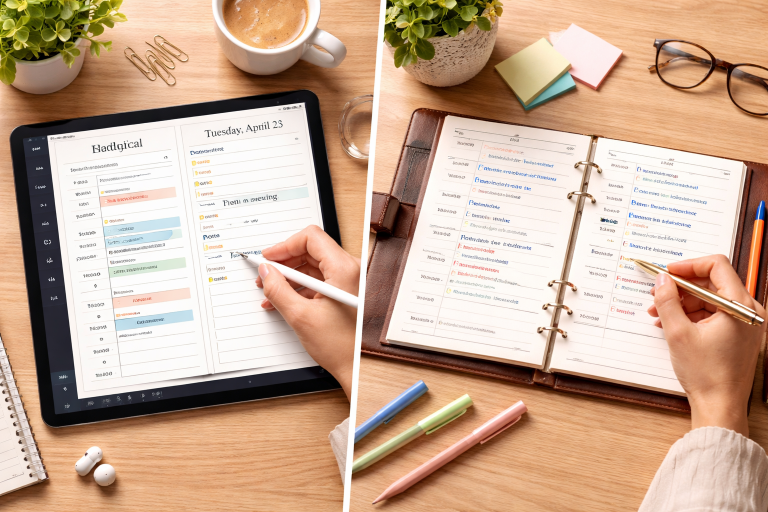
While some prefer digital calendars like Google Calendar, Outlook, or dedicated time management apps, others find solace in the analogue world of physical planners and notebooks. The “best” tool is the one you will consistently use. Digital calendars offer the advantage of easy drag-and-drop rescheduling and recurring events, while physical planners provide a tactile experience that some find more engaging. Experiment with both to see which resonates most with your working style. The key is to have a visual representation of your schedule that you can easily refer to and update throughout the day.
Identifying Your “Big Rocks”
Before you even touch your calendar, take some time to identify your “big rocks”—the most important, high-priority tasks that absolutely must get done. These are the tasks that move the needle forward on your goals, whether professional or personal. Don’t get bogged down in every minute detail; focus on the 3-5 critical items that will make your day feel productive and accomplished. These “big rocks” will form the foundational blocks of your schedule, with smaller, less critical tasks filling the gaps around them. This initial prioritisation prevents your calendar from becoming a chaotic jumble of minor tasks.
The Power of Batching Similar Tasks
A stellar strategy for beginners is to batch similar tasks together. Instead of checking emails every ten minutes, create a dedicated “email block” once or twice a day. Similarly, set aside time for phone calls, administrative tasks, or creative work. Batching prevents context switching, which is incredibly draining on cognitive resources. Each time you switch from one type of task to another, there’s a mental cost involved in reorienting yourself. By grouping similar activities, you allow your brain to stay in a focused zone for longer, leading to more efficient and higher-quality output.
Now that you understand the principles and have some foundational tools, it’s time to build your first time-blocked schedule. This isn’t a one-and-done process; it’s an evolving document that will adapt as you learn more about your own productivity patterns.
Step 1: Brain Dump All Your Tasks
Before you can organise, you need to know what you’re organising. Take 15-20 minutes to brain dump every single task, appointment, and obligation that comes to mind. Don’t filter or prioritise at this stage; just get everything out of your head and onto paper or a digital document. This comprehensive list serves as your raw material for schedule creation.
Step 2: Estimate Time for Each Task
This is a crucial step that many beginners skip, often leading to an over-optimistic and unsustainable schedule. For each item on your brain dump list, estimate how long it will realistically take to complete. Be honest with yourself. If responding to a complex email usually takes you 15 minutes, block out 15 minutes, not 5. It’s always better to slightly overestimate than underestimate, as this builds in a natural buffer.
Step 3: Prioritize and Identify Your “Prime Time”
Review your brain-dumped list and categorise tasks by priority (A, B, or C, or using a similar system like the Eisenhower Matrix). Simultaneously, identify your “prime time” – the periods of the day when you feel most energised and focused. For many, this is the morning; for others, it might be late afternoon or evening. Reserve these prime time blocks for your most important, high-impact “A” tasks that require deep concentration.
Step 4: Block Out Fixed Appointments First
Begin populating your calendar by adding all your fixed appointments – meetings, classes, appointments, commute times, and personal commitments (like childcare pick-up). These are non-negotiable blocks that provide the framework for the rest of your schedule.
Step 5: Schedule Your “Big Rocks” into Prime Time
Now, take your high-priority “A” tasks and assign them to your identified prime time blocks. These are the tasks where you need to be at your best. Ensure these blocks are clearly labelled and, if possible, uninterrupted.
Step 6: Fill In with Smaller Tasks and Buffer Time
Once your big rocks and fixed appointments are in place, start slotting in your “B” and “C” priority tasks. Remember to batch similar items. Crucially, explicitly schedule breaks, lunch, and buffer time between intense work blocks. Don’t forget open slots for unexpected tasks or quick wins.
Time blocking isn’t a static tool; it’s a dynamic system that can be optimised with various strategies to truly supercharge your productivity. Going beyond the basic framework allows for greater efficiency and sustained focus.
The Parkinson’s Law Principle
Parkinson’s Law states that “work expands to fill the time available for its completion.” Time blocking directly combats this phenomenon. By assigning a specific, finite time block to a task, you create a healthy constraint that encourages efficiency. For instance, if you block out 45 minutes for a report that might typically take an hour, you’re more likely to focus intently and complete it within the allocated time. This applies friendly pressure, prompting you to work smarter and eliminate distractions.
Incorporating “Deep Work” Blocks
Borrowing from Cal Newport’s concept, dedicated “deep work” blocks are sacrosanct periods for cognitively demanding tasks performed in a state of distraction-free concentration. These are your prime time blocks. During these periods, silence notifications, close unnecessary tabs, and inform colleagues or family that you are unavailable. The goal is uninterrupted focus, allowing you to produce high-quality work in less time than if you were constantly interrupted. Schedule these blocks when your energy levels are highest.
Utilizing “Buffer Blocks” and “Flex Time”
No schedule is perfect, and unexpected events are inevitable. Including “buffer blocks” – small 15-30 minute slots between major tasks – allows you to smoothly transition from one activity to the next without feeling rushed or letting minor overruns derail your entire day. Additionally, dedicate a “flex time” block, perhaps at the end of the day or week, to catch up on anything that fell through the cracks, handle unexpected urgent items, or plan for the next day/week. This prevents individual tasks from becoming bottlenecks and helps maintain a sense of control.
Even with the best intentions, time blocking can present its own set of hurdles. Recognising and preparing for these common challenges is key to long-term success.
Dealing with Interruptions and Distractions
The bane of modern productivity, interruptions can quickly dismantle a meticulously crafted time-block schedule. The solution involves a multi-pronged approach. First, communicate your schedule and availability to colleagues and family. Using “do not disturb” signs, setting expectations for response times, and dedicating specific “open door” times can be incredibly effective. Second, leverage technology: silence phone notifications, use website blockers, and close non-essential applications during focused work blocks. Third, cultivate self-discipline. Every temptation to check social media or respond to a non-urgent email is a choice; making the conscious effort to stay focused within your designated block is paramount.
Handling Unexpected Tasks and Emergencies
Life is unpredictable, and emergencies inevitably arise. The key here is not to abandon time blocking altogether but to adapt it. When an urgent, unscheduled task appears, assess its true urgency. Can it wait until your next “flex time” block? If not, identify which of your scheduled tasks can be postponed or shortened to accommodate the new priority. Don’t be afraid to reshuffle your blocks. The beauty of time blocking is its flexibility; it’s a living document. Having that “flex time” also provides a designated slot for these unforeseen demands without completely derailing your most important work.
Avoiding Over-Scheduling and Burnout
A common mistake for beginners is to over-schedule every minute, leaving no room for spontaneity or critical thinking breaks. This leads to a rigid, unsustainable schedule and quickly results in burnout. To avoid this, ensure you explicitly schedule breaks, lunch, and even “thinking time” or “personal time”. Remember the principle of being realistic about task estimations. If a task takes an hour, block an hour, not 30 minutes. Schedule fewer, more impactful tasks rather than trying to cram too much in. The goal is sustained productivity, not a sprint followed by exhaustion.
Time blocking is not a “set it and forget it” solution. It requires regular review and adaptation to remain effective. Consistent evaluation and refinement are what transform it into a truly powerful, personalised productivity system.
Regular Review and Adjustment
At the end of each day or week, take a few minutes to review your time block schedule. Did you stick to your plan? Were your time estimates accurate? What worked well? What didn’t? Use these insights to inform your next day’s or week’s schedule. Perhaps you consistently run over on email time, indicating you need a longer email block. Or maybe you find your energy dips significantly in the afternoon, suggesting that’s a better time for administrative tasks than creative work. This iterative process of review and adjustment is crucial for optimising your system.
Reflecting on Energy Levels and Peak Productivity
Pay close attention to your natural energy cycles throughout the day. Are you a morning person who’s sharpest for complex analytical work before lunch? Or do you hit your stride in the late afternoon for creative tasks? Align your most demanding and important tasks with your peak productivity times. Conversely, schedule less mentally taxing activities, like administrative work or returning phone calls, during your lower energy periods. Understanding and respecting your unique physiological rhythm is a powerful differentiator in effective time blocking.
Incorporating Flexibility and Self-Compassion
While structure is vital, rigidity can be detrimental. Your time block schedule should serve you, not the other way around. Be willing to adjust your schedule when necessary without feeling guilty. Life happens, and sometimes a block needs to be moved or an urgent matter addressed. This doesn’t mean your system has failed; it means it’s adaptable. Practise self-compassion. Some days will be more productive than others, and that’s okay. The long-term goal is consistent progress, not flawless execution every single day. The flexibility built into the system, with buffer blocks and review times, helps absorb these unavoidable deviations.
Observing how others successfully implement time blocking can provide invaluable inspiration and practical ideas for your own schedule. These examples highlight the versatility of the method across diverse roles and personal lives.
The Entrepreneur’s Structured Day
Imagine an entrepreneur utilising time blocking to juggle product development, marketing, and client relations. Their morning might be blocked for “deep work” on critical product features, followed by a dedicated “marketing creation” block for content planning and social media scheduling. An afternoon block could be designated for “client follow-ups and communication”, and perhaps a short “administrative and finance” block before concluding the day with “strategic planning for the week ahead”. Breaks are explicitly scheduled, as is buffer time between these varied tasks, ensuring a productive yet sustainable pace.
The Student’s Academic Power Hours
For a student, time blocking can transform academic performance. A student might block specific “study sessions” for different subjects, ensuring adequate preparation for each. “Assignment completion” blocks with clear start and end times prevent procrastination, while “research time” is carved out for library visits or online data gathering. Critically, “break” blocks are integrated, allowing for mental rest, and “social time” or “hobby time” is also explicitly scheduled, demonstrating that time blocking isn’t solely about work but about managing all aspects of life.
The Remote Worker’s Balanced Approach
A remote worker might use time blocking to clearly delineate work from personal life, a crucial challenge in home-based environments. They might have a “focused project work” block in the morning, a “team collaboration and meetings” block around midday, and a “communication and email response” block in the late afternoon. Importantly, “lunch break”, “exercise”, and “family time” are also firmly etched into their calendar, preventing work from bleeding into personal hours and fostering a balanced existence despite the lack of a physical office boundary. The “end of day review and plan” block helps them shut down professionally and mentally transition to personal time.